
What to look for in an AI SOC platform with transparent reasoning and source citations
On this page
An AI SOC platform will close thousands of alerts a month on your behalf. Most of those verdicts will say “benign,” and nobody on your team will look at them twice. That is the point of automation, and it is also the risk. When a verdict is wrong, the only way to catch it is to read how the system reached it, and many AI tools in security operations hand you a confident paragraph with nothing underneath.
That is why transparent reasoning and source citations have become a buying criterion in their own right. Security leaders need verdicts they can defend to an auditor or a board. Analysts need to check the work in seconds instead of re-running the investigation by hand. This guide covers what transparency in an AI security operations center (SOC) platform actually means, how to test for it during an evaluation, and how Exaforce approaches the problem.
Why explainability decides whether an AI SOC gets trusted
Trust in an AI SOC is earned one verdict at a time. If an analyst can open a closed alert and see which login events, which identity relationships, and which baseline deviations led to the conclusion, they learn to rely on it. If all they find is a summary that sounds right and cites nothing, they start spot-checking everything, and the time savings disappear.
There is also an accountability problem. Auditors, regulators, and customers increasingly ask how security decisions get made, and “the model said so” satisfies none of them. A platform that records its reasoning steps and the evidence behind each one gives you an audit trail you can hand over without reconstructing it after the fact.
Transparency is also how the system gets better. When analysts can see exactly where the reasoning went wrong, their feedback is precise enough for the platform to learn from.
Why many AI SOC tools struggle to show their work
A lot of AI security tooling is a wrapper around a frontier large language model (LLM) pointed at raw log data. That design has structural weaknesses that work directly against transparency. LLMs struggle to hold memory across a long investigation, so the reasoning chain fragments. They reason inconsistently from one run to the next, so the same alert can produce a different verdict and a different explanation tomorrow. And they get expensive on large data sets, which pushes vendors to summarize or truncate what the model sees, making it harder to trace any conclusion back to its source.
When a model reasons over raw text, a “citation” may simply be a log line the model chose to quote. That helps, but it does not tell you whether the model considered the right context, ignored contradicting evidence, or invented a connection between two unrelated events. Hallucination is hardest to catch precisely when the output reads fluently.
What transparent reasoning and source citations should look like
When you evaluate an AI SOC platform, look for these properties in every investigation it produces.
- Evidence attached to each finding, linking every conclusion to the events, entities, and context it relied on so an analyst can verify it in one click
- Visible reasoning steps that show the checks the platform ran, including the ones that came back clean
- Deterministic scoring for anomalies and baselines, so the same activity produces the same score every time
- Bounded sources, meaning the reasoning layer only draws on approved data and intelligence and tells you what those sources are
- A complete action log recording what every automated response did, why, and under whose oversight
Most of these have little to do with how well a language model writes. Transparency is largely an architecture decision. A platform that structures data before the AI touches it can cite that structure directly, while an approach built on raw logs is limited to whatever the model decided to quote.
How to test transparency during an AI SOC evaluation
Start with your own alerts. Vendor demos run on curated data that makes every explanation look clean. Pull a handful of closed incidents from the last quarter, including at least one false positive your team spent too long on and one true positive that was hard to spot, then run them through each platform and compare its explanation with what your analysts concluded.
Run the same investigation twice. If the verdict or the explanation drifts between runs, the reasoning is not something you can audit.
Click every citation. Follow the evidence links back to the raw events and check that the cited users, hosts, and sessions exist and that the conclusion actually follows from them. A platform that cites an entity missing from the underlying data is hallucinating with footnotes.
Look for what the platform ruled out. Strong investigations show negative evidence (e.g., no MFA change, no new OAuth grants, a login from a known device). That is what lets an analyst close an alert with confidence rather than simply agreeing with the machine.
If the platform takes containment actions, ask to see one automated action end to end, including the approval path and the log entry it produced. Then ask how analyst feedback changes future verdicts, and whether you can see that change happen.
How Exaforce approaches transparent reasoning
Exaforce is an agentic SOC platform that automates detection, triage, investigation, and response. Its task-specific AI agents, called Exabots, reason over a living map of your environment instead of raw logs, and that design choice is where its transparency comes from.
Exaforce Multi-Model AI divides the work across three specialized models. The Semantic Model resolves entities and the relationships between identities, resources, and actions, and keeps that structured context current. The Behavioral Model learns what normal activity looks like across human and machine identities, applications, data, resources, and locations, then quantifies deviations with explainable anomaly scores. Those scores come from deterministic algorithms rather than LLM estimation, so they don’t vary run to run.
The Knowledge Model is the reasoning layer. It breaks a high-level question into precise checks against the semantic and behavioral layers and reports back summaries with supporting evidence, so analysts and auditors see the answer along with the reasoning behind it. It receives validated entities and calculated scores as input and cannot reason outside the sources you approve. Reasoning steps are logged, and every action is recorded for oversight.
Response follows the same principle. Exabot Respond takes automated actions with analyst oversight, and teams that run the platform themselves keep full visibility into every decision and action the Exabots take. Teams that would rather hand off operations can use Exaforce MDR, a 24/7 managed detection and response service that runs the same Exabots and produces the same explainable verdicts. Either way, the AI agents take on the tedious investigation work and your analysts stay in control of the decisions that matter.
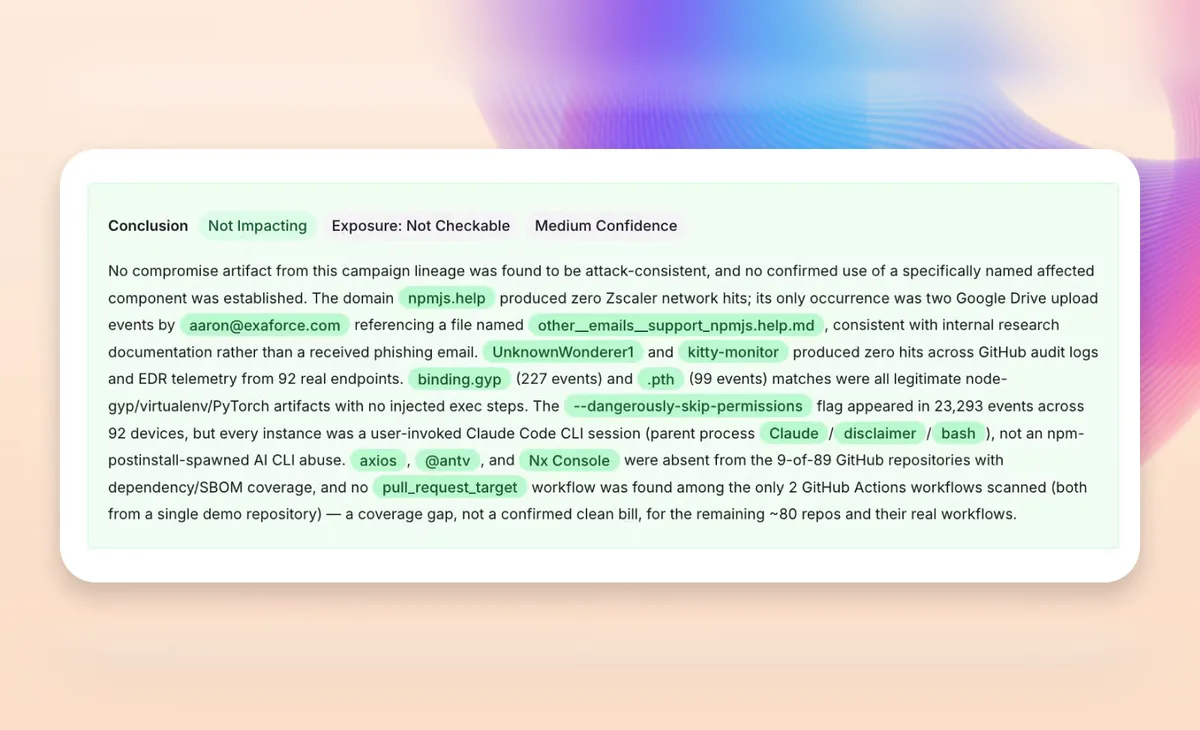
What explainable verdicts look like in practice
During a live incident, Guardant Health used Exaforce to disprove a suspected AWS account compromise in about 15 seconds. Speed like that is only useful when the team can see why the verdict holds, because a fast “benign” with no evidence behind it would leave the incident open in everyone’s mind.
Forcepoint replaced a legacy managed security service provider (MSSP) with Exaforce. Today 95% of its alerts are auto-triaged as verified false positives, and its mean time to respond (MTTR) on P0 incidents is 14 minutes. Closing that share of alerts automatically is only sustainable when any one of those closures can be opened, read, and checked against its evidence.
Choosing the best AI SOC platform for your team
The best AI SOC platform with transparent reasoning and source citations is the one your analysts stop second-guessing, because checking its work takes seconds. Fluent summaries are easy to produce. Evidence that traces back to real events, scores that hold steady across runs, and an action log you can hand to an auditor are much harder, and they are what to test for.
Bring your own alerts to every evaluation, re-run investigations, click the citations, and read the action logs. If you are a mid-market team with an established security information and event management (SIEM) deployment, you can run Exaforce alongside it and compare verdicts on the same alerts before changing anything else.
Request more information about Exaforce